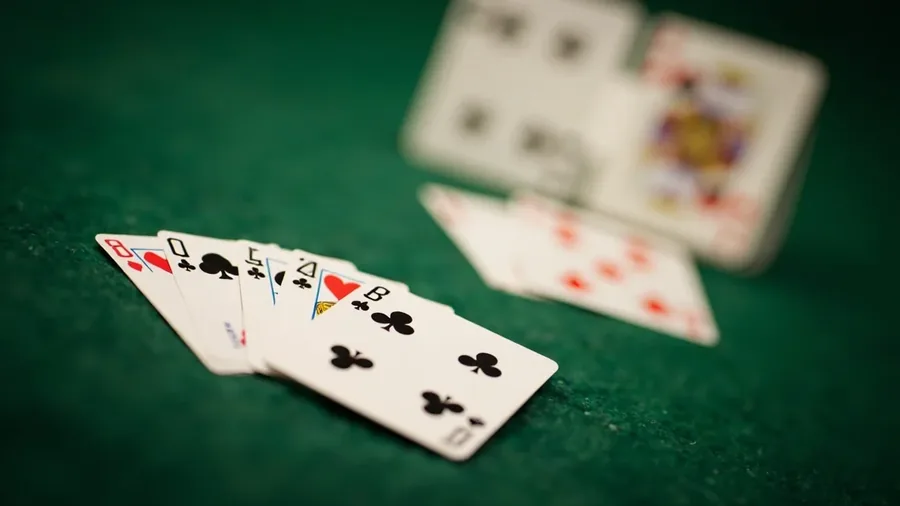
How to play 13-card rummy in plain language.
A complete walk-through of a single hand of Indian 13-card rummy. From the deal and the wild joker to the declaration and the score settlement. No jargon, no shortcuts, no skipped steps.
The deal.
Two standard 52-card decks are shuffled together with two printed jokers, making 106 cards in total. Cards are dealt one at a time, clockwise, until each player at the table holds 13 cards. The next card is turned face up to start the open discard pile; the rest of the deck becomes the closed stock pile.

The player to the dealer's left starts. Play proceeds clockwise. Each turn, every player must pick one card and discard one card. The only exception is the declaration move, which replaces the discard.
The wild joker.
After the deal, the top card of the closed stock pile (the card just under the open discard) is turned face up. Its rank becomes the wild joker for this hand. Every card of that rank in any suit becomes a wild joker, in addition to the two printed jokers.

Wild jokers can substitute any card to complete a group. They cannot be declared as a stand-alone card. They have a point value of zero if left ungrouped at the end of the hand, which is why an unused joker is a small problem only — a losing player would rather drop a joker than drop a face card.
Example. If the up-card is the 7 of hearts, then every 7 in the deck is a wild joker for this hand. A pure sequence 4-5-6-7-8 in spades can use the 7 of hearts in place of the 6, becoming an impure sequence.
Sequences and sets.
Groups come in two forms. A sequence is three or more consecutive cards of the same suit. A set is three or four cards of the same rank in different suits (the 7 of hearts, 7 of clubs, 7 of spades is a set).
- Pure sequence: same suit, no joker used, three or more in order. Mandatory at declaration.
- Impure sequence: same suit, one or more jokers used to bridge a gap.
- Set: same rank, different suits, three or four cards. Jokers allowed.

The rule beginners miss most often: a hand without at least one pure sequence cannot win, even if every other card is grouped. The pure sequence is the spine of the hand, and a player who does not have one by the second half of the hand is usually better off dropping.
Your turn, step by step.
On your turn you do exactly two things. Pick one card — either the top card of the open discard pile or the top card of the closed stock pile. Then discard one card from your hand, face up, onto the open pile.
Picking from the open pile costs nothing and signals your gap to opponents; picking from the closed stock keeps your hand private. Most players alternate between the two, taking from the open pile only when the card fits a known sequence.
Dropping out.
A player may drop at any point before their turn. The penalty depends on when you drop:
- First drop: 25 points (most formats).
- Middle drop: 50 points.
- Full hand completed without declaration: count the ungrouped cards (max 80).
A drop is cheaper than a losing hand in almost every case. The skill is recognising early that a hand has no path to a pure sequence and accepting the small penalty.
Declaration.
When your 13 cards are fully grouped into valid sequences and sets, including at least one pure sequence, you may declare on your turn. Discard one card, then lay your hand face up in groups. The other players and the system verify the groups; if all groups are valid and the declaration is correct, you win the hand.

A wrong declaration (an invalid group, or no pure sequence) is treated as a full losing hand. Always check your groups before declaring; the cost of a wrong declaration is much higher than the cost of one more turn.
Settling the score.
The winner scores zero. Every losing player pays the winner the sum of the point values of their ungrouped cards, capped at 80. Card values: Ace, King, Queen, Jack = 10 each; number cards = face value; jokers and wild jokers = 0.
The cap matters more than beginners expect. A hopeless hand is not the end of the world — the worst you can pay is 80 points. Skill, not luck, decides whether you usually finish well below that cap.
Rules quick reference.
| Element | Standard rule |
|---|---|
| Decks | 2 standard 52-card decks, shuffled together. |
| Jokers | 2 printed jokers + 1 wild joker (the rank of the upturned card). |
| Hand size | 13 cards per player. |
| Mandatory at declaration | At least one pure sequence. |
| Maximum penalty | 80 points. |
| First drop | 25 points. |
| Middle drop | 50 points. |
| Card values | Ace = 10, face = 10, number = face value, joker = 0. |
Common first-hand mistakes.
Three errors account for most first-hand losses. None is fatal; all are easy to avoid once you see them.
- Holding the joker too long. The joker is most valuable at declaration, not on the third turn. Use it where it converts an impure sequence into a pure one.
- Ignoring the discard pile. Your opponents are telling you what they need by what they throw away. Track suits, not single cards.
- Declaring without checking. A wrong declaration is the most expensive move in the game. Always count and verify your groups before laying the hand down.
Move on to strategy.
The strategy chapter covers drop decisions, observation and reading the discard pile, with the limits of each approach.
What experienced players do differently.
The rules above are the entire skeleton of the game. The next-level habits are not about the rules; they are about the choices the rules leave open. Three habits mark the difference between a player who has read the rules and a player who has played the game for years.
The first habit is read the discard pile. Every opponent who picks from the open pile is telling you exactly what they are missing. Track suits, not single cards; if an opponent is collecting hearts, the right move is often to deny them the next heart rather than to chase your own set.
The second habit is hold the joker. Used too early, the joker is a small improvement. Used at the right moment, the joker is the difference between an impure sequence and a pure sequence — and the pure sequence is the only mandatory group.
The third habit is recognise a dead hand early. By about turn eight, if you cannot see a clean path to one pure sequence, the first-drop penalty is almost always cheaper than continuing. Players who drop early preserve their session for hands with real potential; players who never drop lose more than they need to in the long run.
How variations change the rules.
The rules above are the standard 13-card rummy used in most published rule books and most regulated lobbies. Several regional variations exist; each changes at least one rule, so check the published table rules before paying.
- 21-card rummy. A longer hand with three jokers and additional group structures. Common in some regional circles; rarer in online lobbies.
- Pool 101 / Pool 201. Pool rummy with explicit elimination thresholds at 101 or 201 points. The most common pool variation online.
- Best-of-N deals. A fixed number of deals with chips carried forward. The consistency-focused variation.
- Gin rummy. A two-player variant more common outside India, with different declaration rules and no joker.
- Contract rummy. A multi-hand variant where each deal adds new meld requirements.
When in doubt, play the standard 13-card format with the rules above. The standard format is what every published strategy assumes and what every regulated lobby runs by default.
How a one-hand summary helps new readers.
After the deal, every player at the table holds 13 cards. The card just under the open discard pile decides the wild joker for the hand. On each turn, every player picks one card and discards one card, until one player lays down a fully grouped hand that includes at least one pure sequence. That player scores zero; the other players pay the sum of the point values of their ungrouped cards, capped at 80.
That paragraph is the entire skeleton of the game. The rest of this chapter expands each step into the small choices the rules leave open: which card to pick on which turn, when to use the joker, when to drop, and how to verify the hand before declaring. New players who read the one-paragraph summary once and return to it as a reference pick up the mechanics faster than players who try to memorise the rules in order.